Tender Participation Is a Process, Not a One-Time Event
Europe’s public healthcare systems source a large share of their medicines through formal government tenders rather than open-market sales. For pharmaceutical companies, this means that getting into the European market is rarely about a single bid — it is about how well a company can plan, prepare, price, submit, and then deliver on a contract once it is won.
What makes the pharmaceutical tender process Europe unique is that it is not a one-time action. It is a layered progression, where each stage builds on the one before it. A gap in the early stages often leads to complications later, especially during evaluation or execution. For this reason, experienced pharmaceutical companies treat tender participation as a structured internal process, rather than a reactive activity.
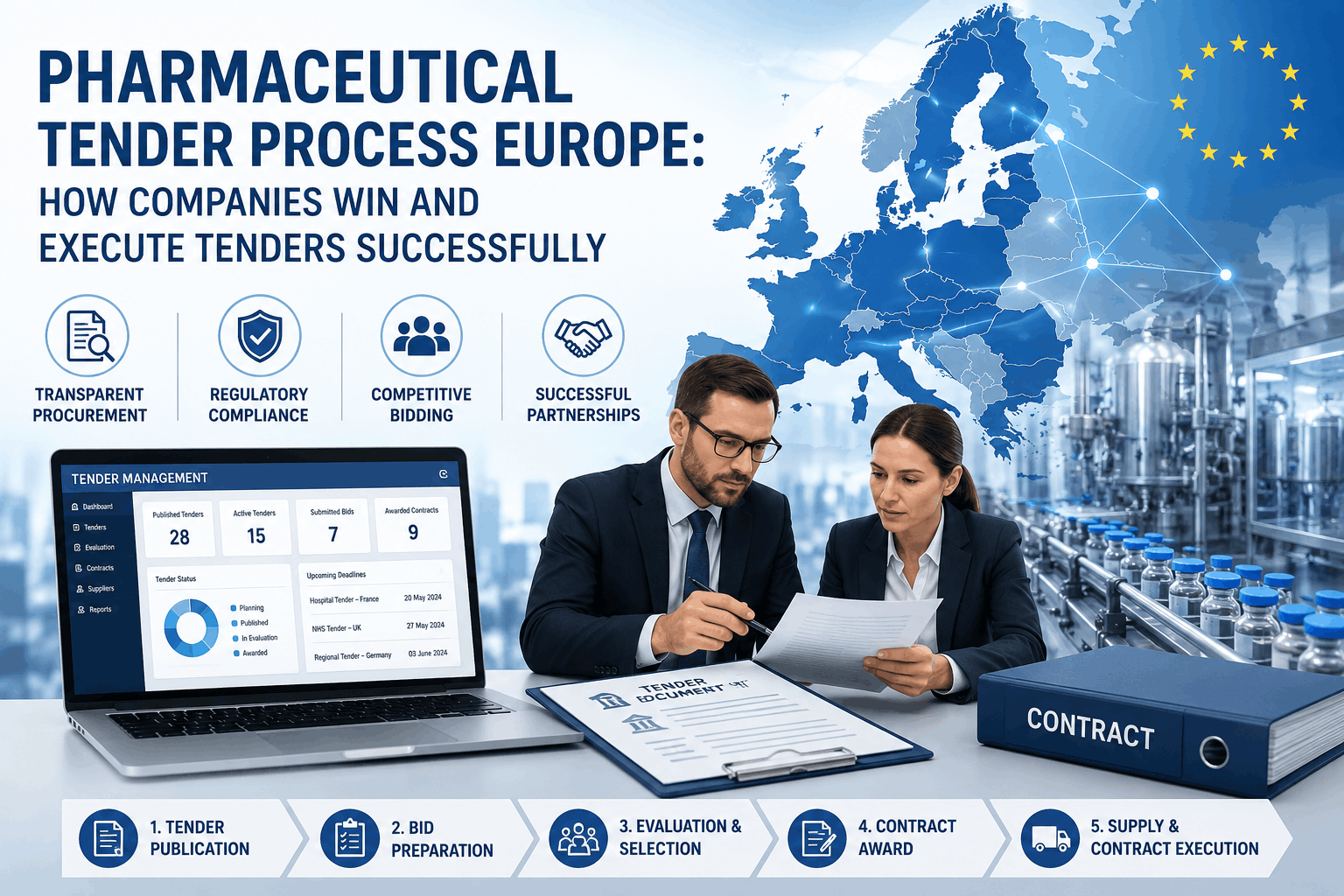
This process broadly moves through:
- opportunity identification and internal evaluation
- documentation alignment and compliance readiness
- pricing strategy and bid structuring
- submission, evaluation, and contract execution
Each of these stages requires careful attention — not just to complete the process, but to ensure the company can sustain what it commits to.
Identifying and Evaluating Tender Opportunities
Looking Beyond the Listings
At a surface level, tenders are accessible through public platforms such as EU portals and national procurement systems. However, simply finding a tender is not enough.
The real decision begins when a company evaluates whether the opportunity aligns with its product portfolio, operational capacity, and long-term strategy. This evaluation matters because once a bid is submitted and awarded, the company is expected to deliver without deviation.
Key Considerations During Tender Selection
Before moving forward, companies typically assess several dimensions of a tender:
- Product alignment with specifications. Tender documents are highly specific, and even small differences in dosage, packaging, or formulation can create compliance issues. A detailed internal check is needed to confirm full alignment.
- Volume expectations and supply capability. Estimated quantities indicate scale, but they also define the level of commitment required over the contract period.
- Contract duration and operational impact. Longer contracts offer stability but require stronger planning for production, inventory, and logistics.
- Market dynamics and competition. Understanding who else may participate helps shape both pricing and positioning strategy.
Why This Stage Matters So Much
This initial filtering stage determines not just participation, but also long-term performance. Companies that skip this step, or treat it lightly, often face supply strain after winning, pricing pressure that affects margins, and operational challenges during execution. The goal here is not to enter more tenders — it’s to enter the right ones.
Reading the Tender Document and Structuring the Response
Reading the Tender as a Strategic Document
Once a tender is selected, the next step is to analyse the tender document in depth. This is not simply about extracting requirements — it’s about understanding the intent behind those requirements. A well-read tender document reveals how the authority prioritizes supply versus cost, whether past supply issues have led to stricter clauses, and how risk is being managed through contract structure.
Core Elements That Need Detailed Attention
- Product specifications and compliance requirements — these define the technical eligibility of the product, and any mismatch can lead to disqualification
- Volume projections and delivery schedules — these show how the authority expects supply to be managed over time
- Contractual terms and penalty clauses — these define the level of accountability expected from the supplier
- Submission structure and documentation requirements — these dictate how the bid must be presented, often in very specific formats
From Understanding to Structuring
After analysing the document, companies begin structuring their response — aligning product data with tender specifications, regulatory documentation with submission requirements, and operational capabilities with contract expectations.
This is where internal coordination becomes essential. Teams across regulatory, supply chain, and commercial functions must work together to ensure the response is not only complete, but internally consistent. Support from experienced partners like Ikris Pharma Network is especially valuable here, helping align documentation with real procurement expectations across different EU markets.
Documentation, Compliance and Internal Alignment
Why Documentation Is More Than Paperwork
In pharmaceutical tenders, documentation is not just a formality — it is the basis of evaluation. Authorities rely on submitted documents to verify product quality, regulatory compliance, and supplier capability. This means documentation must be not only complete, but also accurate, consistent, and clearly structured.
Key Documentation Areas
- Technical documentation — product specifications, manufacturing details, and regulatory approvals
- Compliance declarations — confirming adherence to EU standards and tender-specific requirements
- Company credentials — demonstrating financial strength and operational capacity
Common Challenges
Even experienced companies can face issues such as inconsistencies between documents, missing or outdated certifications, and misalignment between product details and tender requirements. These issues may seem minor, but during evaluation they can raise concerns about a supplier’s reliability.
Avoiding this requires coordination between regulatory teams ensuring compliance, operations teams confirming supply capability, and commercial teams aligning the overall bid. Without this alignment, even a technically strong bid can appear inconsistent.
Pricing Strategy: Balancing Competitiveness with Sustainability
Why Pricing Needs a Long-Term View
Pricing is one of the most visible aspects of any tender — and one of the most sensitive. Unlike open-market sales, tender pricing is typically fixed for the duration of the contract. Companies must think beyond immediate competitiveness and consider long-term sustainability.
Factors That Shape Pricing Decisions
- Production and sourcing costs over time, which may fluctuate, especially for raw materials
- Logistics and distribution expenses, including transportation, storage, and handling
- Market positioning and external impact, since pricing in one tender can influence expectations in other regions through reference pricing systems
- Risk buffers, to account for uncertainties such as demand variation or cost changes
The Risk of Over-Aggressive Pricing
While lower pricing can increase the chances of winning, it can also create long-term challenges: reduced margins affecting sustainability, increased pressure on supply operations, and risk of underperformance during execution. Experienced companies aim for balanced pricing, where competitiveness does not compromise delivery capability.
Submission, Evaluation and Contract Award
Submission: A Process That Demands Precision
Once the bid is fully prepared, it moves into the submission phase — a highly structured stage where strict adherence to guidelines is essential. Every submission must follow the specified format, include all required documents, and meet defined deadlines. Even small deviations can result in disqualification.
Evaluation: A Multi-Layered Review
After submission, authorities evaluate bids based on multiple criteria, typically including:
- Technical validation — ensuring the product meets all specifications
- Pricing assessment — comparing cost structures while considering sustainability
- Supplier capability review — assessing whether the company can deliver consistently
Contract Award: The Beginning of Responsibility
When a contract is awarded, the focus shifts from strategy to execution. The supplier is now responsible for maintaining agreed supply levels, adhering to delivery schedules, and meeting all contractual obligations. At this stage, flexibility is limited, and performance becomes the defining factor.
Execution: Where Strategy Is Tested in Reality
Delivering Over Time, Not Just Once
The final stage of the tender process is execution — and this is where the real complexity lies. Supplying under a tender requires continuous coordination across manufacturing (to ensure consistent production), inventory management (to balance supply and demand), and logistics (to maintain timely delivery).
What Defines Successful Execution
- consistent product availability
- adherence to delivery timelines
- the ability to manage unexpected disruptions
Winning a tender creates opportunity, but delivering it successfully builds credibility with procurement authorities, stronger positioning in future tenders, and long-term market presence. This is how companies move from being participants to becoming reliable partners within the system.
Where the Pressure in Tender-Based Markets Comes From
European procurement systems are designed to optimise cost efficiency while ensuring uninterrupted supply. This creates a natural tension: authorities aim to reduce pricing, while suppliers must maintain quality and consistency within those financial limits. Over time, success in this market is defined not by entry alone, but by the ability to operate sustainably under pressure.
This pressure typically comes from:
- Continuous pricing compression — repeated tender cycles often push prices downward, especially in highly competitive segments like generics
- Strict contractual obligations — once pricing and supply terms are agreed, there is limited room for adjustment
- High expectations around supply continuity — any disruption is taken seriously, particularly in public healthcare systems where patient care is directly affected
Managing Risk in European Pharmaceutical Tenders
While tenders offer structured access to large markets, they also come with risks that are often underestimated at the entry stage.
Key Risk Areas
- Supply chain vulnerability — even a well-planned contract can be affected by delays in raw materials, manufacturing issues, or logistics disruptions, so companies must build buffer capacity and contingency plans
- Pricing sustainability risk — aggressive pricing may secure contracts but can create long-term financial strain if costs rise unexpectedly
- Regulatory and compliance risk — any change in product status, documentation gaps, or audit issues can affect ongoing supply obligations
- Market dependency risk — relying heavily on a few large tenders can create instability if those contracts are lost in future cycles
How Experienced Companies Manage Risk
Rather than avoiding risk, experienced companies manage it through diversified market participation, conservative and realistic pricing models, and strong internal coordination between supply, regulatory, and commercial teams — allowing them to remain stable even in highly competitive environments.
Building a Long-Term Tender Strategy
One of the most important shifts companies make over time is moving from a tender-by-tender approach to a long-term strategy. Instead of focusing only on winning individual contracts, companies begin thinking about where they want to establish a consistent presence, which products are best suited for tender-based markets, and how to build credibility with procurement authorities.
Elements of a Strong Tender Strategy
- Selective participation — not every tender needs to be pursued; choosing the right opportunities improves both success rates and execution quality
- Operational readiness — aligning manufacturing, logistics, and compliance systems before bidding ensures smoother execution later
- Reputation building — consistent delivery over time creates trust, which often influences future procurement decisions indirectly
- Market understanding — each EU country operates differently, and adapting to these differences is key to sustained success
This is where experienced partners such as Ikris Pharma Network play a critical role — helping companies not just enter the market, but navigate it with a structured and informed approach.
Supplier Positioning: What Actually Sets You Apart
In a market where multiple suppliers may offer similar products, differentiation becomes less about the product itself and more about how the supplier operates. Over time, procurement authorities begin to recognise patterns in supplier behaviour.
Factors That Influence Supplier Positioning
- Consistency in delivery — suppliers who meet timelines without disruption are valued more than those who only compete on price
- Clarity in documentation and communication — well-structured submissions and transparent communication reduce friction during evaluation and execution
- Ability to handle complexity — managing large volumes, multiple locations, or sensitive supply conditions strengthens credibility
Strong positioning leads to better chances in future tenders, inclusion in framework agreements, and stronger relationships with procurement bodies — the path by which companies gradually move from being participants to becoming preferred suppliers.
Frequently Asked Questions (FAQs)
1. Is the lowest price always the deciding factor in European tenders?
Not necessarily. While pricing is important, authorities also evaluate supply reliability, compliance, and operational capability. A very low price that raises concerns about sustainability may not always be selected.
2. Can new companies enter the European tender market easily?
Entry is possible, but it requires preparation. New companies often begin with smaller or regional tenders to build experience and credibility before moving to larger national contracts.
3. Are tender volumes guaranteed once a contract is awarded?
In traditional tenders, volumes are usually estimated but not always guaranteed. In framework agreements, there is often no fixed volume commitment, and supply depends on actual demand.
4. How long do pharmaceutical tender contracts typically last?
Contract durations vary by country and tender type, but they often range from one to several years. Longer contracts require stronger planning and operational stability.
5. What happens if a supplier fails to meet supply commitments?
Failure to deliver can lead to penalties, contract termination, and reduced chances of winning future tenders — which is why execution is as important as winning.
6. Do all EU countries follow the same procurement process?
No. While there are shared principles at the EU level, each country has its own procurement systems, platforms, and evaluation criteria.
7. Can pricing in one tender affect pricing in other markets?
Yes. In some cases, reference pricing systems link prices across countries, which means tender pricing decisions can have broader implications.
8. How can companies improve their chances of success in tenders?
Success generally depends on a combination of strong documentation, realistic pricing, reliable supply capability, and a good understanding of local procurement systems.
Final Thought: Success Is Measured After the Win, Not At It
Winning a European pharmaceutical tender is an achievement, but it is also the start of a longer responsibility. Companies that succeed in this market are the ones that prepare thoroughly, price sustainably, manage risk proactively, and execute reliably — turning a single contract into the foundation of an ongoing relationship with procurement authorities.
In the end, success in this market is not about how many tenders a company wins. It is about how reliably it can operate within the system once it does.